
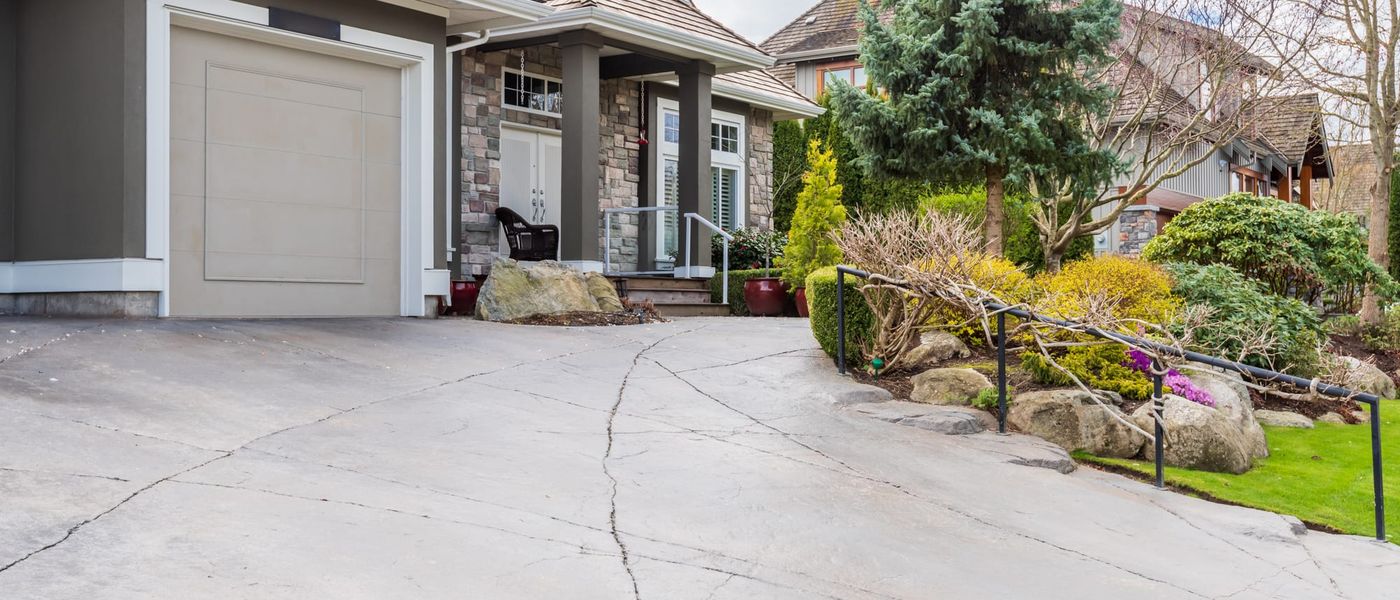
A poured slab is rigid. The ground under it is not, and when that ground moves, the slab has nowhere to go but down. Almost every sunken driveway, walk or patio we see traces back to something that happened underneath, not to the concrete itself.
The slab was never the problem. What changed is the soil or fill it was resting on, usually months or years after the pour, and usually somewhere water had a way in.
The three usual suspects
- Washed-out fill: loose backfill under a driveway apron or walk, compacted poorly or eroded by runoff over the years.
- A leaking or disconnected downspout: water dumping next to the foundation for a season is enough to hollow out the soil beneath a nearby slab.
- Expansive clay: soil that swells when it is wet and shrinks when it dries, which can pump a slab up and down until it settles unevenly.
- An old root or stump that finally rotted away, leaving a void nobody knew was there until the slab found it.
Because a slab is poured in one piece but the ground under it fails in patches, the drop is rarely even. A driveway settles at the garage apron first, or one panel of a walk dips while its neighbours stay level — the joints are exactly where the stress shows first.
The first sign is usually small: a trip edge at a joint, a puddle that used to drain, a gap opening under one corner. None of those get better on their own, and every one of them is worth a look before the drop doubles.